


Determining the appropriate number of industrial fiberglass fans for a space is a crucial task that requires careful consideration of various factors. As a reputable supplier of industrial fiberglass fans, I've encountered numerous clients grappling with this challenge. In this blog, I'll share insights and a step - by - step approach to help you make an informed decision.
Understanding the Basics of Industrial Fiberglass Fans
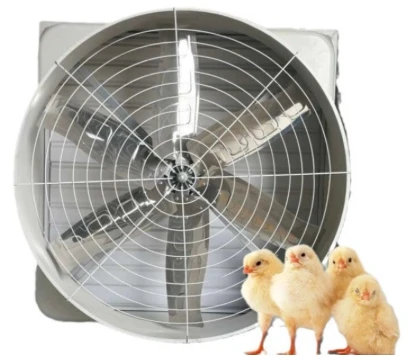
Industrial fiberglass fans are renowned for their durability, corrosion resistance, and high - performance capabilities. They are widely used in various industrial settings, including factories, warehouses, and chemical plants. These fans come in different sizes, types, and airflow capacities to meet diverse ventilation needs. For instance, our Large Airflow And Good Price Frp Ventilation Industrial Exhaust Fan is designed to provide significant airflow at an affordable price, making it suitable for large - scale industrial spaces.
Factors to Consider When Determining the Number of Fans
1. Space Size and Volume
The first and most obvious factor is the size and volume of the space. Larger spaces generally require more fans to ensure adequate ventilation. To calculate the volume of a rectangular space, you can use the formula: Volume = Length × Width × Height. For irregularly shaped spaces, you may need to break the area into smaller, regular shapes and calculate their volumes separately before summing them up.
Once you have the volume, you need to determine the air changes per hour (ACH) required for the space. ACH is the number of times the entire volume of air within a space is replaced with fresh air in one hour. Different industries and applications have different ACH requirements. For example, a manufacturing facility with high levels of dust and fumes may require 6 - 12 ACH, while a warehouse may need 2 - 4 ACH.
2. Airflow Requirements
Each fan has a specific airflow capacity, usually measured in cubic feet per minute (CFM). To determine the total CFM required for the space, multiply the volume of the space by the desired ACH and divide by 60 (since there are 60 minutes in an hour). For example, if you have a space with a volume of 10,000 cubic feet and you want 6 ACH, the total CFM required would be (10,000 × 6) / 60 = 1000 CFM.
After calculating the total CFM, you need to select fans with appropriate airflow capacities. Our High Quality And Good Price Large Airflow Frp Ventilation Industrial Exhaust Fan offers a high CFM rating, which can be an excellent choice for spaces with high - volume ventilation needs.
3. Fan Placement and Distribution
Proper fan placement is essential for effective ventilation. Fans should be distributed evenly throughout the space to ensure uniform airflow. Consider the layout of the space, including the location of doors, windows, and equipment. For example, if there are areas with high heat or pollutant sources, fans should be placed strategically to direct airflow towards these areas.
In some cases, you may need to use a combination of exhaust fans and supply fans. Exhaust fans remove stale air from the space, while supply fans bring in fresh air. A balanced ventilation system with the right combination of exhaust and supply fans can improve the overall ventilation efficiency.
4. Environmental Conditions
The environmental conditions within the space also play a role in determining the number of fans. If the space has high humidity, high temperatures, or contains corrosive substances, you may need to choose fans made of materials that can withstand these conditions. Fiberglass fans are an excellent choice for such environments due to their corrosion - resistant properties. Our Fiberglass Fan for Factory Use is specifically designed to operate in harsh industrial environments.
Step - by - Step Process to Determine the Number of Fans
Step 1: Calculate the Space Volume
As mentioned earlier, measure the length, width, and height of the space and use the appropriate formula to calculate the volume.
Step 2: Determine the ACH
Research the ACH requirements for your specific industry and application. You can consult industry standards, local building codes, or ventilation experts for guidance.
Step 3: Calculate the Total CFM Required
Use the formula (Volume × ACH) / 60 to calculate the total CFM needed for the space.
Step 4: Select the Fan Type and Capacity
Based on the total CFM and the environmental conditions, select the appropriate fan type and capacity. Consider factors such as fan efficiency, noise level, and maintenance requirements.
Step 5: Determine the Number of Fans
Divide the total CFM required by the CFM capacity of each fan. If the result is not a whole number, round up to the next whole number to ensure sufficient ventilation.
Example Calculation
Let's assume we have a manufacturing facility with the following specifications:
- Length = 100 feet
- Width = 50 feet
- Height = 20 feet
- Desired ACH = 8
First, calculate the volume of the space:
Volume = 100 × 50 × 20 = 100,000 cubic feet

Next, calculate the total CFM required:
Total CFM = (100,000 × 8) / 60 ≈ 13,333 CFM
Suppose we select a fan with a CFM capacity of 2000 CFM. Then the number of fans required would be:
Number of fans = 13,333 / 2000 ≈ 6.67
Rounding up, we would need 7 fans.
Conclusion
Determining the appropriate number of industrial fiberglass fans for a space is a complex but essential process. By considering factors such as space size, airflow requirements, fan placement, and environmental conditions, you can ensure that your ventilation system operates efficiently and effectively.
If you're still unsure about how many fans you need for your industrial space, our team of experts is here to assist you. We offer a wide range of high - quality industrial fiberglass fans to meet your specific needs. Contact us to discuss your requirements and start the procurement process. We look forward to helping you create a well - ventilated and healthy industrial environment.
References
- ASHRAE Handbook of Fundamentals. American Society of Heating, Refrigerating and Air - Conditioning Engineers.
- Industrial Ventilation: A Manual of Recommended Practice. American Conference of Governmental Industrial Hygienists.


